

Transvaginal ultrasound
What does it consist of?
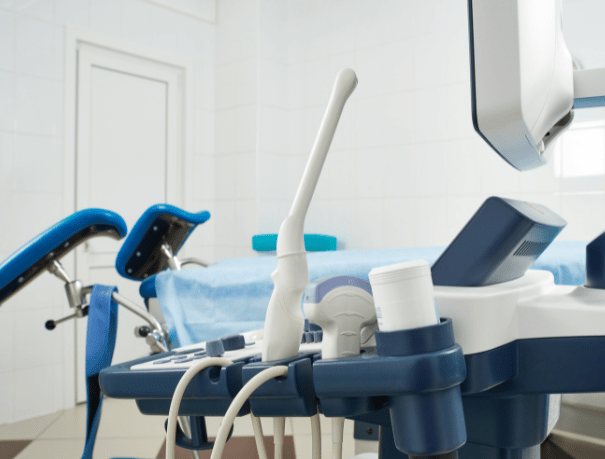
During the examination, the specialist moves the transducer over the area of the body to be studied, having previously applied a gel. This transducer sends sound waves (ultrasound) that “bounce” off different organs and tissues, forming the image.
To whom?
Your doctor may recommend a transvaginal ultrasound in the following cases:
- Pelvic pain.
- Visualization of abnormal alterations in a gynecological examination, such as cysts, fibroid tumors or other neoplasms.
- Abnormal vaginal bleeding and menstrual problems.
- Certain types of infertility.
- Ectopic pregnancy.

Preparation for the test
Instructions
This test does not require any specific preparation. You can lead a normal life.
Medical professionals
The specialists who will assist you at CreuBlanca
A team of professionals to take care of you.


CreuBlanca centers
Find your nearest CreuBlanca center

Barcelona
CreuBlanca Tarradellas
Related articles
CreuBlanca's blog
You will find from the hand of our professionals advice to improve your health and information on the latest technologies applied in the health sector.
 Diagnostic Tests
05 Oct 2026
7 Min
How to speed up the diagnostic process: The advantages of having a private medical test.
When a doctor requests a diagnostic test (such as an MRI, a CT scan, an ultrasound, or an endoscopy), getting the results quickly is essential to start the right treatment. However, waiting times for these tests can sometimes stretch to weeks or even months.
 Diagnostic Tests
28 Sep 2026
3 Min
Do you need an urgent CT scan or PET-CT scan? When to choose a private center.
In certain medical scenarios, time is not just a matter of comfort, but a clinical necessity. When a doctor requests an urgent CT scan or a PET-CT test, it is usually to confirm a suspected diagnosis, evaluate treatment progress, or plan an intervention as a priority.
 Diagnostic Tests
02 Sep 2026
4 Min
CT Scan (TAC): when is it indicated and what diseases it helps detect
A CT scan (Computed Tomography), also popularly known as a CAT scan or scanner (TAC in Spanish), is one of the most widely used and decisive diagnostic imaging tests in modern medicine. It allows for a precise three-dimensional X-ray of the inside of the body in just a few seconds.