

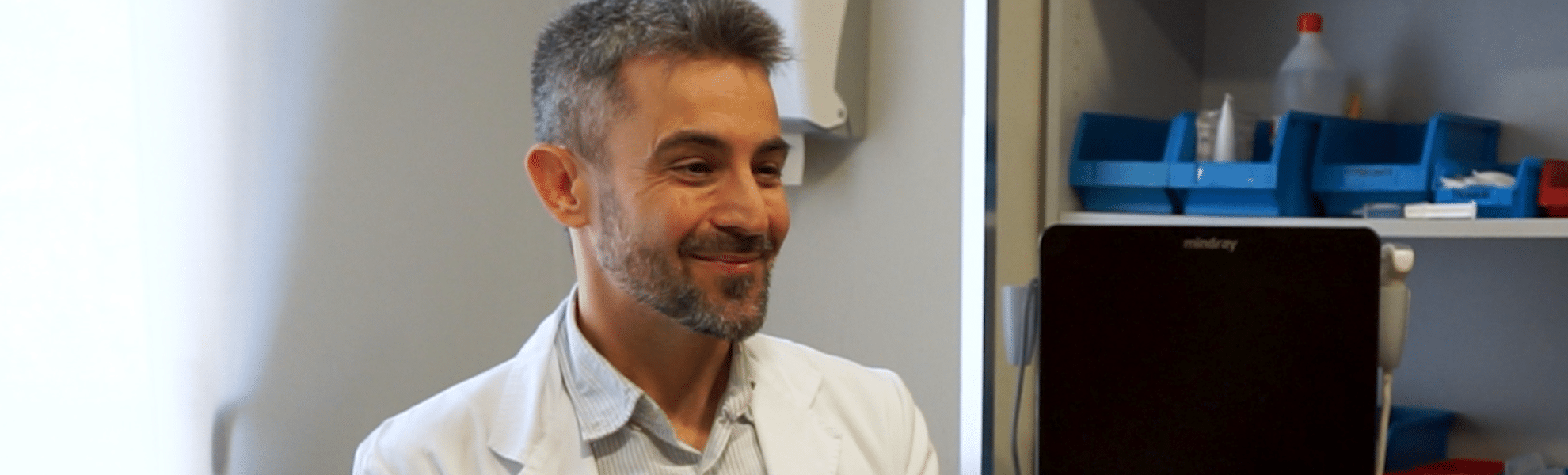
There are stories that do not begin with a professional decision, but with an entire life tied to a place.
In Dr. Miret’s case, his relationship with CreuBlanca runs so deep that it is part of his own personal history. The grandson of the founders, he grew up among corridors, consulting rooms and summers of work that allowed him to get to know the institution from the inside long before becoming a doctor.
What attracted you to CreuBlanca, and what surprised you most when you first arrived?
In my case, my connection with CreuBlanca goes back a very long way. I was literally born here: my grandparents were the founders, and I have spent my entire life surrounded by this institution. From a very young age, I spent my summers working at CreuBlanca; I have been a hospital orderly, taken X-rays, worked with patients… until finally specialising in urology.
I have always felt at home here, and that is something very difficult to explain if you haven’t experienced it from the inside.
What led you to specialise in urology and prostate health? What do you enjoy most about your day-to-day work?
I chose urology because it is a medical-surgical specialty. I have always liked surgery, but I did not want to lose direct contact with patients.
Urology allows me to maintain a very close relationship with patients in the consultation room while also developing the surgical side, which is one of my great passions as a doctor. That balance is what motivates me most in my daily work.
Urology deals with very personal issues. What do you enjoy most about working with patients?
Working with patients is, without a doubt, one of the aspects I enjoy the most. I have often been told that I have a friendly and straightforward personality, and it is true that I ask very clear, sometimes very direct questions.
Patients are sometimes surprised at first, but they later appreciate it. Urology allows you to convey closeness and personality, and to create a space of trust where patients can talk about fears or very intimate problems. Being able to help in that area is enormously rewarding and gives great meaning to my profession.
What medical or technological advances are truly changing the way patients are diagnosed and treated?
Minimally invasive surgery has brought about a real revolution in urology. Although it has existed for years, it has evolved exponentially over the past decade and has allowed us to do things that were previously unthinkable.
I would also highlight magnetic resonance imaging, which is one of the main pillars of modern urology, especially here at CreuBlanca. It has transformed diagnosis: today we detect lesions and diagnose prostate cancer much earlier than with conventional biopsies.
Artificial intelligence is already part of medicine. How do you think it can transform your work, especially in urology?
Artificial intelligence is something we must integrate, without question; otherwise, it will overtake us. In urology, it can add enormous value, particularly in clinical diagnosis.
For example, in the monitoring of urine cultures, in optimising antibiotic treatments, or in supporting patients with kidney stones through automated follow-up systems.
It will also be key in the interpretation of imaging tests, helping us detect increasingly smaller or more difficult-to-identify lesions. And in the surgical field, virtual reality assistants can be an extremely valuable learning tool, especially for surgeons at the beginning of their careers.
Looking ahead, how do you imagine CreuBlanca in 10 years’ time?
We are living through a very exciting period, especially with the Mataró project. The transition from a clinic to a hospital is a very significant step.
In ten years, I imagine CreuBlanca fully consolidated, operating at full capacity, providing excellent care to patients and, as always, committed to the most cutting-edge technology.
What message would you like to leave for CreuBlanca on its 75th anniversary?
I would like to tell it not to change anything… and to change everything. To keep moving forward, innovating and looking to the future, but never losing the essence with which my grandfather started 75 years ago: caring for patients and always offering the very best medicine possible.