

Magnetic resonance imaging is one of the most advanced tools in diagnostic imaging. It allows the study of organs, tissues, and internal structures with great precision and without using ionizing radiation.
In recent years, this technology has undergone a major evolution thanks to the incorporation of artificial intelligence (AI) into image acquisition and reconstruction systems. This integration is transforming the way MRI scans are obtained and processed, improving image quality, optimizing examinations, and facilitating the work of specialists.
The new generation of MRI systems incorporates these technologies with the aim of enabling increasingly efficient, precise, and patient-adapted examinations.
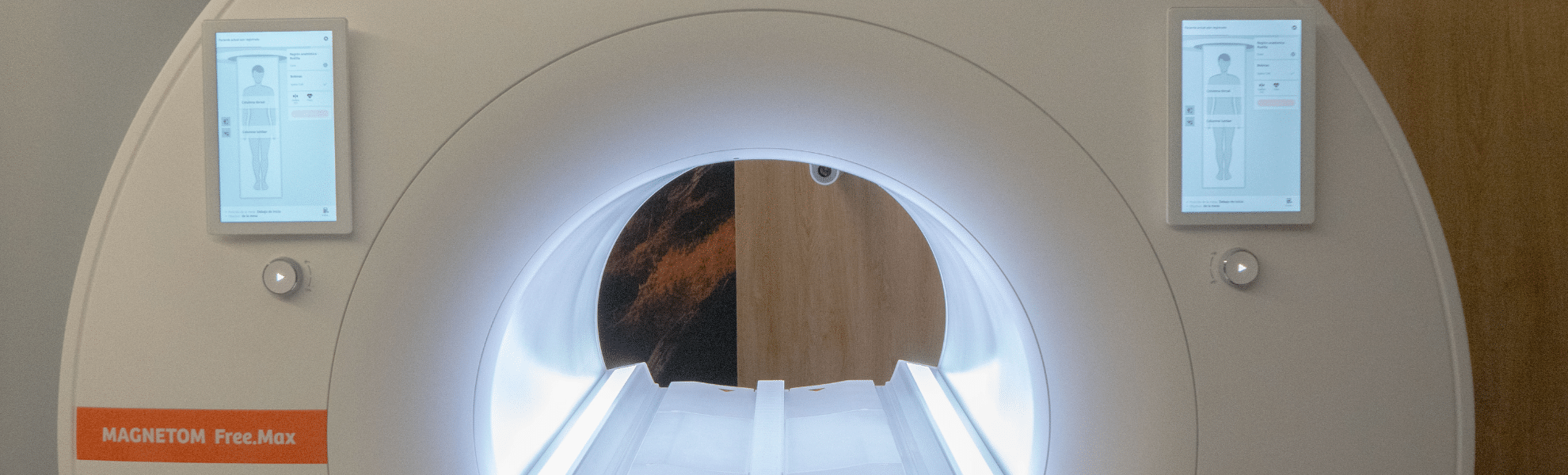
At CreuBlanca we have recently incorporated a new MRI system that integrates these artificial intelligence technologies: Siemens MAGNETOM Free.Max. These types of systems aim to improve the patient experience and optimize image quality, facilitating examinations even in situations that traditionally could be more challenging, such as in people with anxiety or claustrophobia.
How artificial intelligence is applied in MRI
When we talk about artificial intelligence applied to magnetic resonance imaging, we are mainly referring to its use to optimize the technical processes that allow medical images to be obtained and reconstructed.
The interpretation of the images and the final diagnosis remain the responsibility of the radiology specialist.
In practice, deep learning algorithms analyze large volumes of previous MRI data to learn how to reconstruct images more efficiently. This makes it possible to optimize different aspects of the examination, such as:
- The reduction of noise in images.
- The improvement of resolution and detail.
- The optimization of the image reconstruction process.
These tools are part of a new generation of technologies known as deep learning-based reconstruction, which are already being incorporated into the most advanced MRI systems.
A technological leap in image quality
One of the major challenges in magnetic resonance imaging is achieving high-quality images while maintaining an efficient acquisition process.
Artificial intelligence-based techniques help address this challenge through advanced reconstruction systems capable of identifying patterns in the signal obtained during the examination and processing it more accurately.
In clinical terms, this translates into:
- Sharper images.
- Better contrast between tissues.
- Clearer visualization of complex anatomical structures.
This advancement can be particularly relevant in studies where image quality is essential for medical interpretation.
A more comfortable MRI: a wider bore that reduces the feeling of confinement
In addition to advances in artificial intelligence, the latest generation of MRI systems also incorporates improvements designed to make the examination more comfortable for patients.
One of the aspects that concerns many patients most is the feeling of confinement during the examination. To reduce this discomfort, some modern systems feature a wider-than-usual bore, offering more space inside.
This design helps reduce the sensation of confinement during the scan and can be especially useful for people with claustrophobia or anxiety when undergoing an MRI scan.
Improving the patient experience is becoming an increasingly important factor in the technological development of these systems.
The evolution of MRI: digital technology and AI
The incorporation of artificial intelligence into magnetic resonance imaging is part of a broader evolution in the field of diagnostic imaging.
New-generation MRI systems integrate different technological innovations:
- More advanced digital processing systems.
- New image reconstruction algorithms.
- Optimization of radiology workflows.
- Better integration with hospital information systems.
All of this helps improve the efficiency of the diagnostic process and facilitates the work of healthcare professionals.
Artificial intelligence and radiology: a support tool for specialists
AI is gradually being incorporated into different areas of radiology, not only in magnetic resonance imaging.
Currently, it is used to support various tasks, such as:
- Improving image reconstruction.
- Automating certain technical processes.
- Optimizing examination protocols.
- Facilitating the review of large volumes of studies.
However, it is important to emphasize that artificial intelligence acts as a support tool, not as a substitute for medical judgment. Clinical interpretation and diagnosis still depend on the expertise of the specialist.
The future of magnetic resonance imaging
The incorporation of artificial intelligence marks a new stage in the evolution of diagnostic imaging.
Current advances point towards systems increasingly capable of processing large volumes of data, optimizing image quality and improving examination efficiency. All with the aim of enabling more precise diagnoses and contributing to increasingly personalized healthcare.
In this context, magnetic resonance imaging continues to consolidate itself as one of the fundamental tools of modern medicine, and the integration of artificial intelligence opens new possibilities for the development of this technology in the coming years.